
Why Your Healthcare Costs Rise Even in “Good” Years

You didn’t have a bad year. Claims weren’t catastrophic. So why is your renewal still going up?
Table of Contents
- This probably sounds familiar
- The big misconception: Good year = lower costs
- What’s really driving cost increases even in good years
- The real problem: You’re playing defense in a system built against you
- What employers are actually feeling right now
- What needs to change: From reactive to strategic
- How Trinity changes the equation
- It doesn’t have to be this way
- Key Takeaways
This probably sounds familiar
You review your year.
Claims were stable. Nothing unusual showed up. No catastrophic cases. No major surprises that made you stop and rethink everything.
Overall, it felt like a good year.
So naturally, you expect a manageable renewal. Maybe not perfect, but reasonable. Something you can explain. Something that makes sense.
And then the numbers come in. Another increase. Another tough conversation with leadership. Another moment where you are expected to explain why costs are going up when nothing really went wrong.
And that is where the frustration starts to build.
Because this goes beyond the numbers. It is the budget, the pressure to keep everything on track, and the conversations that come with it. The pressure to keep costs under control. The conversation you are about to have with your CFO, who is asking the same question you are asking yourself.
What happened?
There is also that underlying concern that never really goes away. If this is what a “good” year looks like, what does a bad one look like?
So you go back through everything again. You double check the data. You try to find the reason that justifies the increase.
But nothing stands out.
And that is the part that makes it even more frustrating.
It does not feel like a bad year, so why does your renewal feel like one?

The big misconception: “Good Year = Lower Costs”
There is a natural expectation that comes with a good year.
When claims are stable and nothing out of the ordinary happens, it feels reasonable to expect some level of consistency moving forward. A calmer year should lead to a calmer renewal.
That is how most things work, but healthcare does not follow that logic.
Year after year, many employers experience steady claims, minimal disruption, and still face rising costs. It creates a disconnect that is hard to explain and even harder to plan around.
Because the reality is, healthcare costs move on their own timeline.
They are influenced by factors that go far beyond what is happening inside your organization. Provider pricing continues to increase, pharmaceutical costs keep evolving and carrier models are designed to protect margins over time.
All of this continues in the background, regardless of how your plan performs in a given year.
So even when things feel stable internally, the external pressure never really slows down.
Your costs aren’t just reacting to your employees, they’re reacting to the entire system.
What’s really driving cost increases even in good years
By the time renewal comes around, it can feel like costs moved without a clear reason, but there are patterns behind it, hey just are not always visible.
Medical inflation doesn’t take a break
Healthcare costs tend to move in one direction.
Hospital systems and providers continue to increase prices year after year. Contracts are often structured in a way that supports those increases over time, which means those changes build quietly in the background.
Even in a stable year, those underlying costs continue to rise.
Pharmacy costs are quietly exploding
Pharmacy spend has become one of the fastest moving parts of any health plan.
Specialty medications, chronic condition treatments, and newer therapies continue to reshape overall costs. GLP one medications alone have changed the conversation for many employers.
At the same time, pricing is not always clear. Discounts, rebates, and contracts add layers that make it difficult to understand what is really being paid.
Carrier pricing Strategies
Carriers are constantly managing risk across their entire book of business.
Pricing models are built to maintain stability and protect margins over time. Adjustments can happen regardless of how a single group performs, especially when broader trends are pushing costs upward.
This is why renewals can feel disconnected from the actual experience of the year.
Lack of visibility = Lack of control
For many employers, the full picture is never completely clear.
There is limited access to the data behind the numbers. It becomes difficult to pinpoint what is driving spend or where adjustments could be made. Decisions end up happening at renewal, under time pressure, with incomplete information.
And that makes it harder to shift from reacting to planning.
Even when your plan performs well, the system around it is still pushing costs up.
The real problem: You’re playing defense in a system built against you
At this point, the pattern starts to feel familiar.
Each year brings a new set of numbers, each renewal brings a new round of decisions and most of the effort is focused on responding to what is already in front of you.
That is where many employers find themselves. Managing costs at renewal time, trying to make the best decision with the information available in that moment but most of what is driving those costs has already been set in motion long before that conversation happens.
There is very little influence over the factors shaping the renewal. The timing is tight, the data is limited, the options feel narrow and that is where the pressure builds.
It can feel like negotiating without leverage. Trying to manage costs without a clear view of what is actually driving them. Making important decisions while still missing part of the picture.
Over time, it creates a cycle that is difficult to break.
Costs rise. Decisions are made. Another year passes. And then it all comes back again.
Most employers are working within a model that doesn’t naturally reward stable performance.

What employers are actually feeling right now
At some point, the questions start to repeat themselves.
- How do we budget for something we cannot fully predict?
- Why are costs going up when everything felt stable?
- How is this supposed to make sense year after year?
There is also the pressure that comes with explaining it.
Sitting in a meeting, walking through the numbers and knowing the question is coming before it is even asked.
How do I explain this to our CFO again?
And underneath all of it, a bigger question starts to take shape:
Is there any way to actually control this?
Because at a certain point, it stops feeling like a one time challenge and it starts to feel like a pattern.
What needs to change: From reactive to strategic
At some point, it becomes clear that reacting once a year is not enough.
Renewal conversations carry too much weight. Too many decisions are being made in a short window of time, often based on limited visibility into what is actually driving costs.
A different approach starts to take shape.
One that is not centered around a single moment in the year, but built around what is happening throughout the year.
Ongoing cost management creates space to understand trends as they develop. It allows adjustments to happen earlier, before they show up in the renewal.
Visibility also begins to change the conversation.
When there is a clearer view into where spend is going, decisions feel more grounded. Patterns become easier to identify. Opportunities to improve start to stand out.
Over time, this leads to more informed decisions. More proactive planning. A stronger sense of control over the direction of the plan.
And the focus starts to shift.
The goal is to bring clarity and control to renewal decisions.
How Trinity changes the equation
At some point, the question shifts from “Why is this happening?” to “What can actually be done about it?”
This is where a different kind of support starts to matter.
Trinity works alongside employers as a partner in navigating these decisions, bringing clarity to what often feels complex and difficult to control. Instead of focusing only on renewal season, the approach expands to what is happening throughout the year and how those decisions shape long term outcomes.
One of the most impactful shifts many employers explore is moving away from fully insured plans toward level funded models.
In a fully funded plan, costs are largely fixed and determined by the carrier, with limited visibility into what is driving spend. In a level funded model, there is more transparency, more flexibility, and the opportunity to align costs more closely with actual performance over time.¹
For many organizations, this creates a more balanced approach. It combines predictability with greater insight, allowing for better decision making throughout the year.
With that foundation in place, the conversation starts to change.
Trinity supports employers in building a clearer, more structured approach to managing healthcare costs.
What this looks like in practice
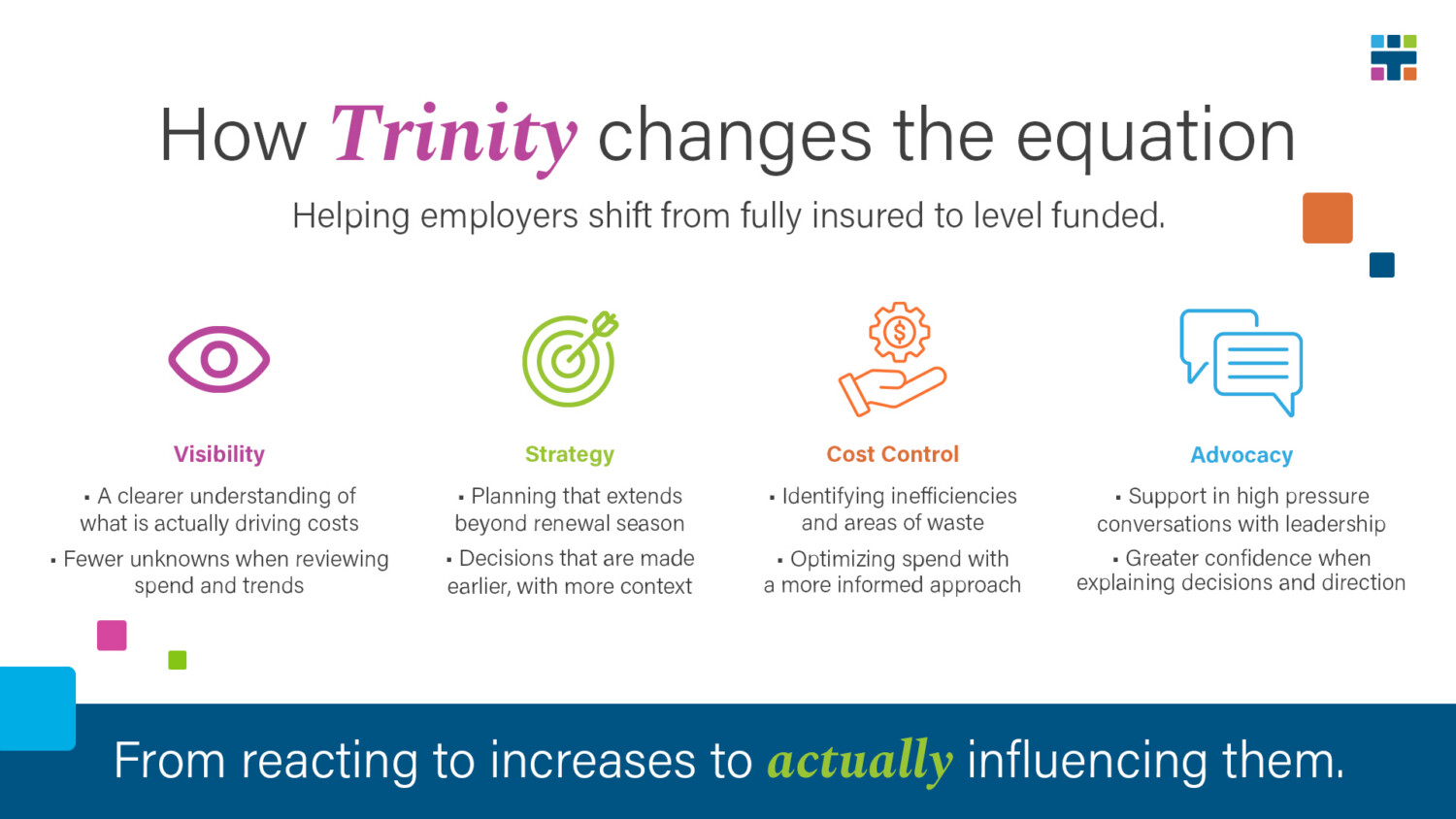
Over time, this creates a different experience.
More clarity. More control. More confidence in the decisions being made.
Trinity helps employers move from reacting to increases to actually influencing them.
It doesn’t have to be this way
By now, the pattern is clear.
Rising costs, difficult renewals, and conversations that feel harder every year are part of the experience many employers share. It can start to feel like something that simply has to be managed, year after year.
But there is another way to approach it.
A more structured way to understand what is driving costs. A clearer path to making decisions with confidence. A steadier approach that brings more predictability into the process.
For many organizations, that shift begins with better visibility, more consistent planning, and the ability to act earlier in the year.
Over time, those changes start to add up.
Conversations become more grounded. Decisions feel more supported. The renewal process becomes more familiar, more expected, and easier to navigate.
And most importantly, there is a stronger sense of direction.
Healthcare costs may continue to evolve, but the way they are managed can feel very different.
Healthcare costs may keep rising, but how you manage them doesn’t have to stay the same.
Key Takeaways
- A “good” year does not always lead to a lower renewal
Stable claims do not prevent costs from increasing across the system. - Healthcare costs are influenced by more than your plan’s performance
Medical inflation, pharmacy trends, and carrier pricing continue to evolve in the background. - Renewals often reflect decisions and trends from months before
By the time numbers are presented, many cost drivers have already taken shape. - Limited visibility makes cost management more difficult
Without clear insight into what is driving spend, decisions become reactive. - A more strategic approach creates better outcomes over time
Ongoing planning, clearer data, and earlier decision making help bring more control into the process. - The right support can change how costs are experienced and managed
With better structure and guidance, renewals become more predictable and easier to navigate.
Footnote Markers: